
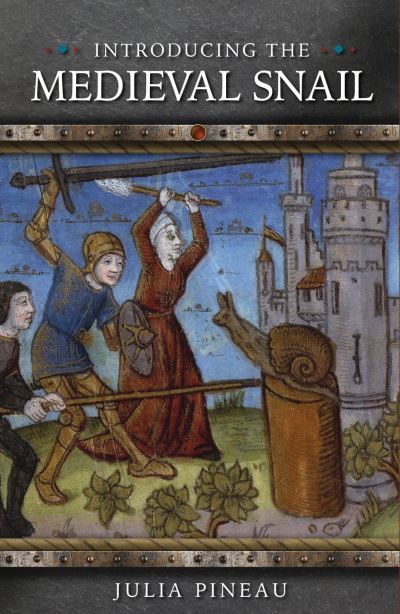
Introducing the Medieval Snail
When one thinks about medieval animals, snails rarely come to mind. Just as history has long had its biases, so has the study of animals – both have long focused on the ‘crowned heads’. A focus on the seemingly insignificant, on the small and the frail, offers a fresh point of view. This book studies the uses and representations of medieval snails, spanning material culture, medicine and gastronomy as well as a great variety of texts and images – taking into consideration bestiaries, sermons, poems and insults, as well as marginalia, sculpture, paintings and painted ceilings. Observing the Middle Ages from the viewpoint of a snail can be surprising, and lead us to delve into material everyday life as well as the core of culture-building.
£14.99
In stock
When one thinks about medieval animals, snails rarely come to mind. Just as history has long had its biases, so has the study of animals - both have long focused on the 'crowned heads'. A focus on the seemingly insignificant, on the small and the frail, offers a fresh point of view. This book studies the uses and representations of medieval snails, spanning material culture, medicine and gastronomy as well as a great variety of texts and images - taking into consideration bestiaries, sermons, poems and insults, as well as marginalia, sculpture, paintings and painted ceilings. Observing the Middle Ages from the viewpoint of a snail can be surprising, and lead us to delve into material everyday life as well as the core of culture-building. This study concludes with a novel reading of the famed 'snail-combat motif', in which a knight cowers faced with a ferocious mollusc, making a connection between Gothic marginalia and a new, most malleable cultural expression: the meme.
Additional information
| Dimensions | 198 × 129 mm |
|---|---|
| Author | |
| Publisher | University of Wales Press |
| Imprint | University of Wales Press |
| Cover | Paperback |
| Pages | 144 |
| Language | English |
| Edition | |
| Dewey | 594.309 (edition:23) |
| Readership | Professional and scholarly / Code: H |