
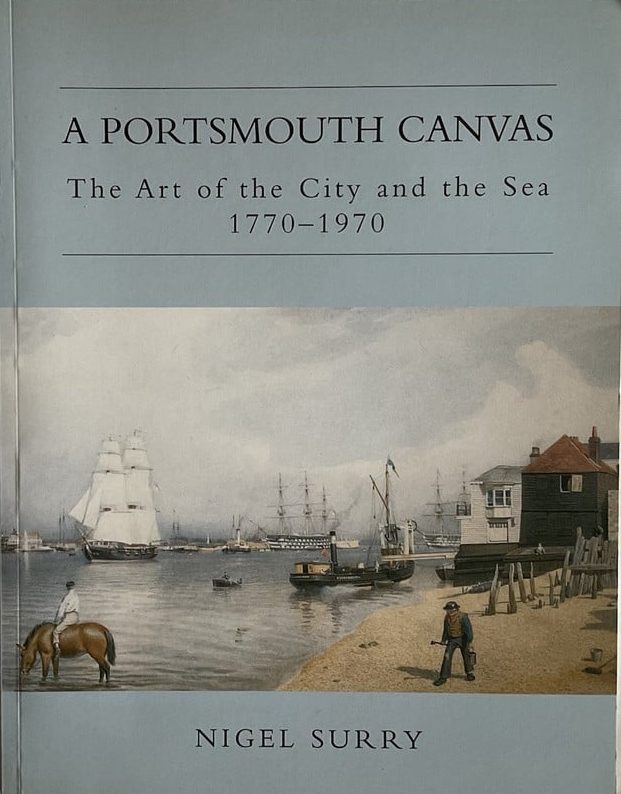
A Portsmouth Canvas
What factors brought artists as distinctive as Rowlandson, Turner and Whistler to Portsmouth? And how successful was the town, from its years as ‘the chief naval arsenal in the world’ in mid Victorian times and beyond, in nurturing and sustaining a growing number of painters, including J.C. Schetky, George Cole, and W.L. Wyllie?
Portsmouth was well placed for travellers of all kinds visiting the Isle of Wight or New Forest in search of ‘picturesque’ scenery, their numbers swelling with the coming of the railways in the 1840s, and the development of Southsea as a watering place. The popularity of marine and landscape painting,, together with frequent naval reviews encouraged artists to the area from the 1770s onwards such as William Daniell, E. W. Cooke, and Henry Dawson, contributing to the emergence of a group of indigenous painters, including W.H.C. Ubsdell, H.Coish and W.E. Atkins.
The wars of the last two hundred years were a factor luring artists to the town, from James Northcote in 1776 to J.D. Fergusson and Eric Ravilious during the First and Second World Wars respectively, while the damage inflicted by enemy bombing in the 1940s was chronicled in graphic detail by Edward King. The uncertainties and hopes of the postwar decade found expression in Eric Rimmington’s Trafalgar House Mural (1949), raising the curtain on the 70s and 80s, which saw the first steps of Portsmouth’s transformation from a dockyard town to a thriving university city.
The book is largely based on contemporary sources, including the letters, diaries and memoirs of more than 50 artists, accompanied by over 100 illustrations, 32 of which are in colour.
£17.95
In stock
Additional information
| Weight | 423 g |
|---|---|
| Dimensions | 246 × 189 mm |
| Author | |
| Publisher | Fortune |
| Imprint | Fortune |
| Cover | Paperback |
| Pages | 88 |
| Language | English |
| Dewey | 758.7422792 (edition:22) |